A full post-processing pipeline
Screen-space ambient occlusion, MSAA and FXAA, bloom, chromatic aberration, film grain, and refraction on the glass blocks — composited every frame without dropping below 60.
Work
Every consultancy claims it can build. Below is something you can run in your own browser and judge for yourself — no slides, no case-study PDF.
Demonstration · Real-time 3D
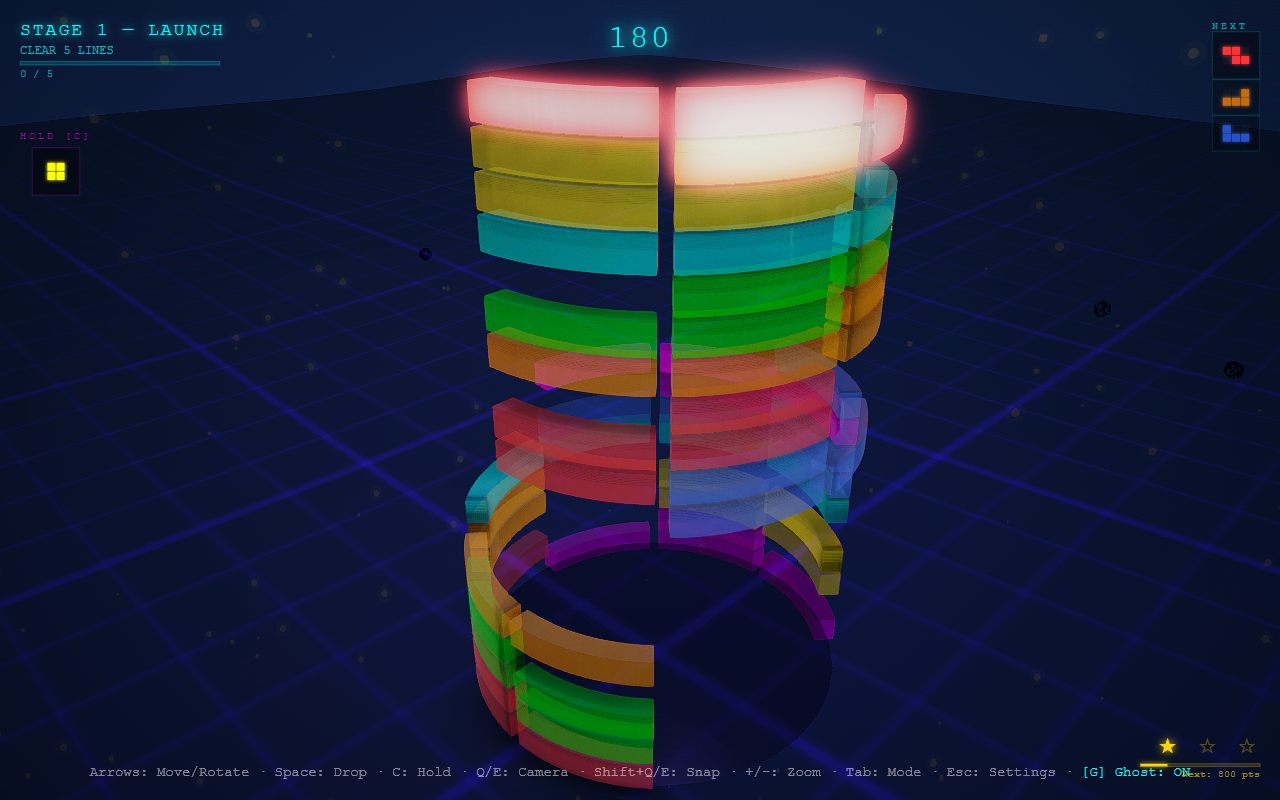
Tetris played on the outside of a cylinder, in a browser, at 60fps. Built as a deliberate stress test: a project with real-time rendering, precise input timing, and enough systems depth that shortcuts would show.
Under the hood
A game is a convenient proving ground: it has to be correct, fast, and pleasant to use at the same time, and any one of the three failing is immediately obvious.
Screen-space ambient occlusion, MSAA and FXAA, bloom, chromatic aberration, film grain, and refraction on the glass blocks — composited every frame without dropping below 60.
DAS and ARR key-repeat tuning and a 7-bag randomiser: the details that separate a game that feels right from one that feels approximately right. Invisible when correct.
Every collision, rotation, and line clear works in cylindrical coordinates, where column zero and column eleven are neighbours. Off-by-one errors have nowhere to hide.
Meteors, gravity wells, ice-locked rows, solar flares, and cylinder rotation — each a separate module, sequenced by a stage runner rather than bolted onto the game loop.
The first three seconds sample the frame rate and step the quality preset down if the hardware needs it, so a modest laptop gets a playable game instead of a slideshow.
31 ES modules served directly, unit tested, roughly 390 KB of application code. Nothing to compile, nothing to break in a toolchain six months from now.
How it was built
This is the honest version, because it is the part that matters commercially.
Why this matters to you. The interesting number is not that AI wrote code. It is that a project of this size and finish came from one person in three months. That ratio is what we bring to your build — and it is why a boutique practice can quote timelines that normally require a team.
Describe what you need. We will tell you plainly what it takes and how long it will run.